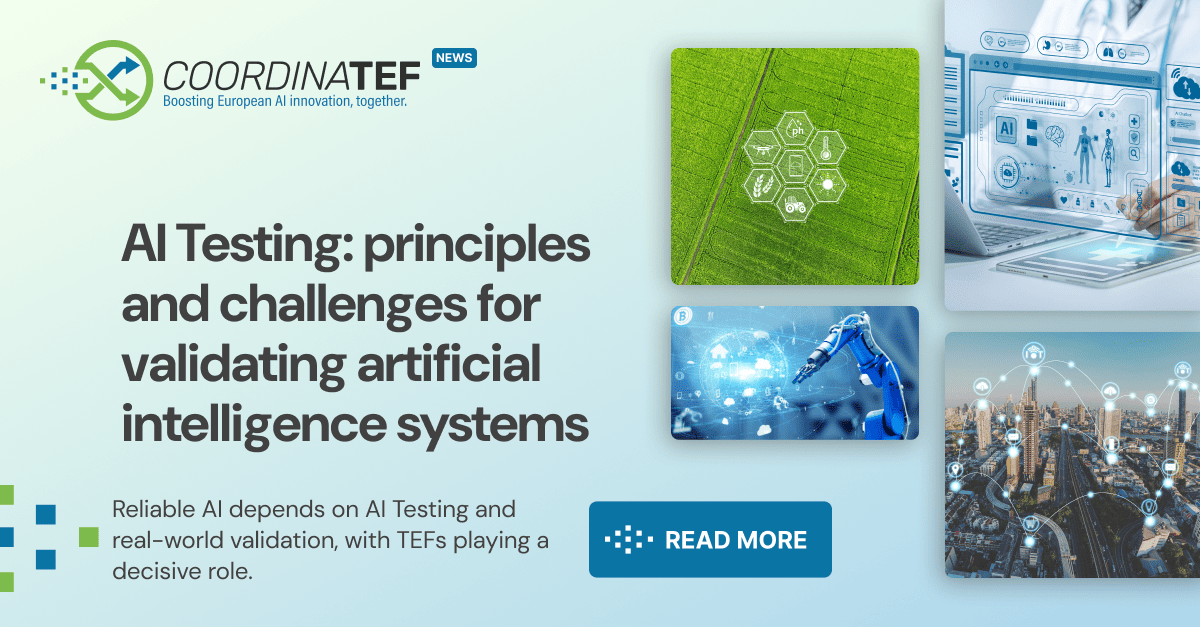
Artificial intelligence is playing an increasingly central role in decision-making processes, production systems, and infrastructure across multiple sectors.
However, as AI models become more complex and are increasingly deployed in real-world environments, the need to ensure that these systems are reliable, safe, and consistent over time is also growing.
In this context, AI Testing represents a fundamental element for evaluating the behavior of artificial intelligence systems beyond the development phase, under dynamic and often unpredictable operational conditions.
AI Testing is therefore not an isolated phase of the software lifecycle, but a continuous process that accompanies the design, validation, and deployment of intelligent systems.
AI Testing and real-world experimentation environments
AI Testing can be defined as the set of methodologies and practices used to assess the quality, reliability, and robustness of artificial intelligence systems.
Unlike traditional software systems, AI models:
- learn from data,
- can change their behavior over time,
- produce non-deterministic outputs.
For this reason, AI Testing is not limited to functional verification but extends to more complex dimensions, including model robustness, bias management, operational safety, and generalization capability.
The goal of AI Testing is therefore to ensure that intelligent systems behave consistently and safely even under conditions that were not anticipated during training. However, with the increasing adoption of AI in critical sectors, a key challenge emerges: the need to test systems not only in laboratory environments but also in realistic and representative operational contexts.
This has led to the development of dedicated infrastructures for large-scale experimentation and validation, capable of supporting the entire lifecycle of AI technologies.
In Europe, these infrastructures play a strategic role in building a reliable and interoperable ecosystem for artificial intelligence.
Testing and Experimentation Facilities (TEFs) are sector-specific European infrastructures that, thanks to their services, enable the real-world validation and large-scale testing of artificial intelligence and robotics solutions before their deployment in operational environments.
AI Testing in the agrifood sector
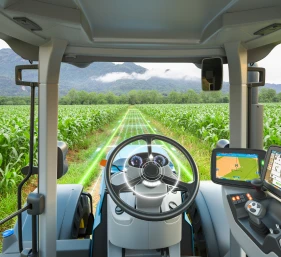
In the agrifood sector, AI Testing is essential for validating solutions applied to agricultural production, automation, and intelligent resource management.
agrifoodTEF is an infrastructure dedicated to the experimentation of AI technologies in the agrifood domain.
In this context, AI Testing enables the evaluation of precision agriculture systems, agricultural robotics, optimization of food supply chains, interoperability between digital systems and physical environments, with the goal of ensuring that AI solutions are reliable and sustainable before large-scale adoption.
AI Testing in smart cities and urban systems
Smart cities represent one of the most complex environments for applying artificial intelligence, as they involve interconnected infrastructures, citizens, and public services.
CitCom.ai provides testing environments for AI solutions applied to urban contexts. In this domain, AI Testing is primarily used to evaluate intelligent mobility systems, urban energy management, digital public services, infrastructure safety and resilience and much more.
The key aspect is not only technical performance but also systemic impact: AI Testing in smart cities also includes the assessment of social implications and sustainability of deployed solutions.
AI Testing in the healthcare sector
In healthcare, AI Testing is critical as it directly relates to patient safety and the quality of clinical decision-making.
TEF-Health supports the experimentation of AI solutions for medical and healthcare applications.
AI Testing in this context focuses on diagnostic support systems, predictive analysis of clinical data, surgical and assistive robotics, regulatory and clinical validation.
The objective is to ensure that technologies are safe, effective, and compliant with regulatory requirements before deployment in real healthcare environments.
AI Testing in manufacturing
In the manufacturing sector, artificial intelligence is increasingly used to automate processes, optimize production, and improve predictive maintenance.
AI-MATTERS represents an infrastructure dedicated to the experimentation of AI and robotics solutions in industrial contexts.
Here, AI Testing applies to advanced robotic systems, production line automation, AI-based predictive maintenance, integration between legacy systems and new technologies.
This allows companies to reduce implementation risks and improve the scalability of intelligent solutions.
The role of AI Testing in the European ecosystem
AI Testing is becoming a structural component of the European innovation ecosystem, particularly in relation to evolving regulatory frameworks and the increasing focus on safety, transparency, and reliability of artificial intelligence systems.
The experimentation infrastructures represented by the TEFs constitute a key element in the transition of AI from experimental technology to mature industrial infrastructure.
In this context, AI Testing is not only a technical phase but a strategic process that connects research, industry, and regulation.
AI Testing is now an essential element in the responsible development of artificial intelligence systems. Its role is not limited to performance verification but extends to validating the full behavior of systems operating in complex and real-world environments.
Through sector-specific infrastructures such as the TEFs, AI Testing becomes a bridge between technological innovation and real-world deployment, contributing to a more reliable, safe, and sustainable AI ecosystem.
To facilitate access to AI Testing services and support stakeholders across sectors, a dedicated CoordinaTEF helpdesk is available to provide information, guidance, and direct orientation within the European Testing and Experimentation Facilities ecosystem.