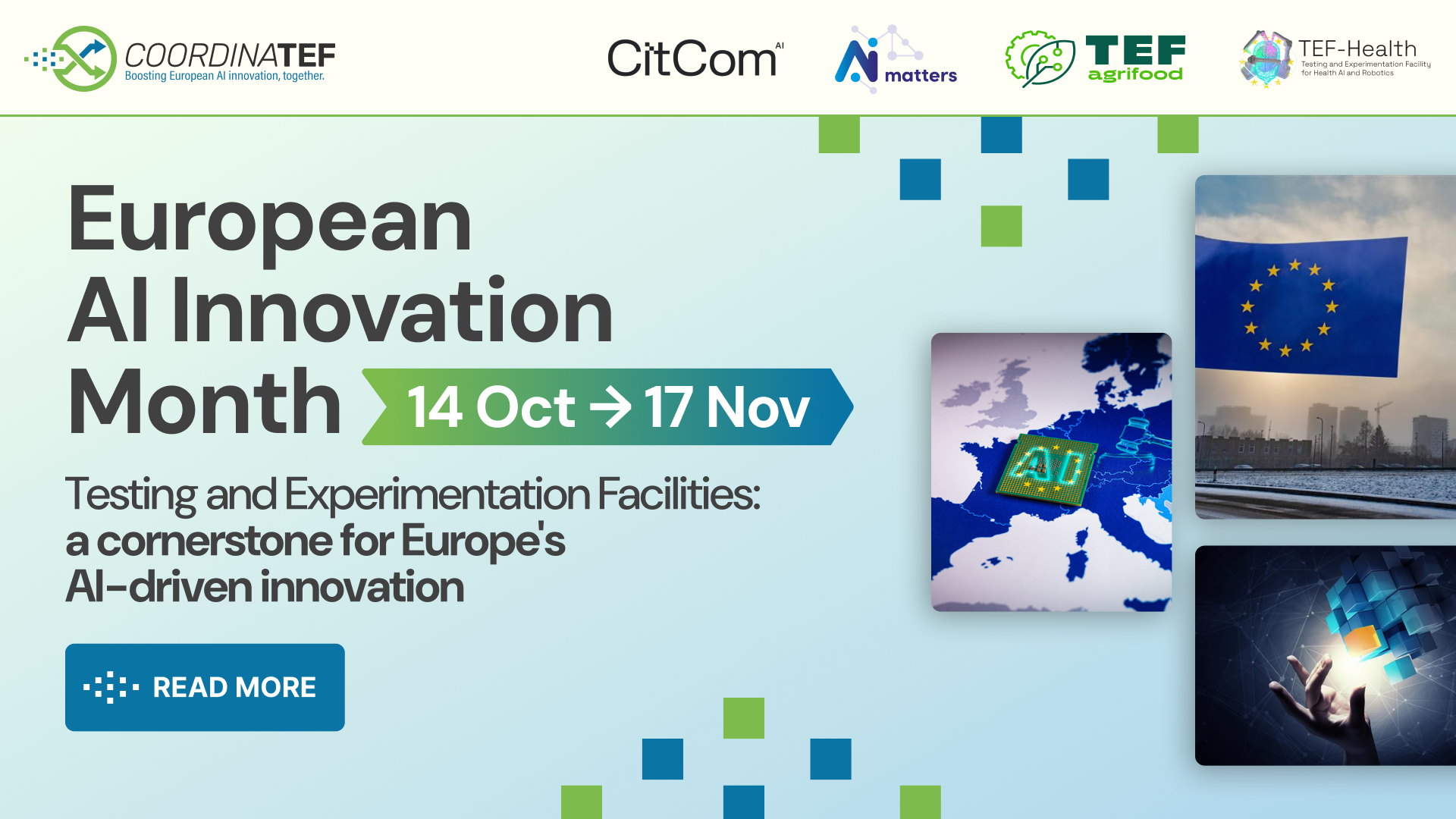
As Europe accelerates its ambition to become a global leader in Artificial Intelligence (AI), the focus is increasingly shifting from research excellence to real-world deployment. The challenge is no longer only about developing advanced technologies, but about ensuring that these innovations are tested, validated and successfully integrated into society and the economy. This is precisely where AI Testing and Experimentation Facilities (TEFs) play a crucial role.
Bridging the gap between innovation and deployment
Europe has long been recognised for its strong research base and scientific excellence. However, transforming this knowledge into scalable, market-ready AI solutions remains a structural challenge. Many organisations – particularly startups and SMEs – face significant barriers when moving from prototype to deployment. Access to real-world physical and virtual testing environments, sector-specific infrastructure and regulatory guidance is often limited and costly, slowing down innovation uptake. Four AI Sectorial TEFs, agrifoodTEF, AI-MATTERS, TEF-Health and CitCom.ai have been established to address this gap. As large-scale European infrastructures, they provide controlled environments where AI solutions can be tested and validated under real-life conditions. This allows innovators not only to fine-tune their technologies, but also to demonstrate their value and readiness for the market.
Enabling trustworthy AI in practice
A distinctive feature of the European approach to AI is its strong emphasis on trust, safety and compliance. With the development of the AI Act and related frameworks, Europe is setting a global benchmark for trustworthy AI. AI Sectorial TEFs are instrumental in translating these principles into practice. They enable companies to assess the robustness, reliability and safety of their systems, while also considering their broader implications. This is particularly important in high-impact sectors such as healthcare, manufacturing, agrifood and smart cities and communities, where AI applications must meet strict requirements.
By embedding regulatory and safeguard considerations into the innovation process, TEFs contribute to shaping an ecosystem where AI made in Europe is not only competitive, but also aligned with European values.
A coordinated ecosystem across sectors
The TEF landscape is organised around key strategic domains – including health, manufacturing, agrifood, and smart communities – each offering specialised expertise and services. Initiatives such as CoordinaTEF ensure that this landscape is connected and mutually reinforcing. Through coordination, knowledge sharing and alignment of approaches, TEFs can operate as a coherent European network rather than isolated initiatives. This cross-sectoral dimension is essential to maximise impact, avoid fragmentation and support the development of interoperable solutions that can scale across different domains and markets.
TEFs do not operate in isolation: they are embedded within a wider ecosystem of European initiatives, including European Digital Innovation Hubs, AI Factories, data spaces, among other key AI enablers. By leveraging upon these complementarities and synergies, TEFs act as bridges between innovation, industrial uptake and policy objectives, facilitating collaboration and knowledge exchange. This ecosystem, and AI Sectorial TEFs role in it, is brought to life through flagship initiatives such as the European AI Innovation Month, which brings together stakeholders from across Europe to showcase ongoing efforts and strengthen links that support the development, adoption, and uptake of AI.
During this month of events, TEFs provide a concrete illustration of how the European AI strategy is being translated into practice, moving from strategic objectives to implementation, and from innovation to impact. By showcasing real use cases and engaging with industry, policymakers and other key stakeholders, TEFs contribute to strengthening the visibility and coherence of the European AI Innovation Ecosystem.
Looking ahead
As Europe continues to invest in AI, the importance of infrastructures that support testing, validation and scaling will only grow. AI Sectorial TEFs are not just supporting individual projects; they are helping to define how AI is developed and deployed across Europe. Their contribution lies in enabling a model of innovation that combines technological excellence with trust, regulatory alignment and real-world applicability. In doing so, they are helping Europe build a distinctive and sustainable approach to AI.