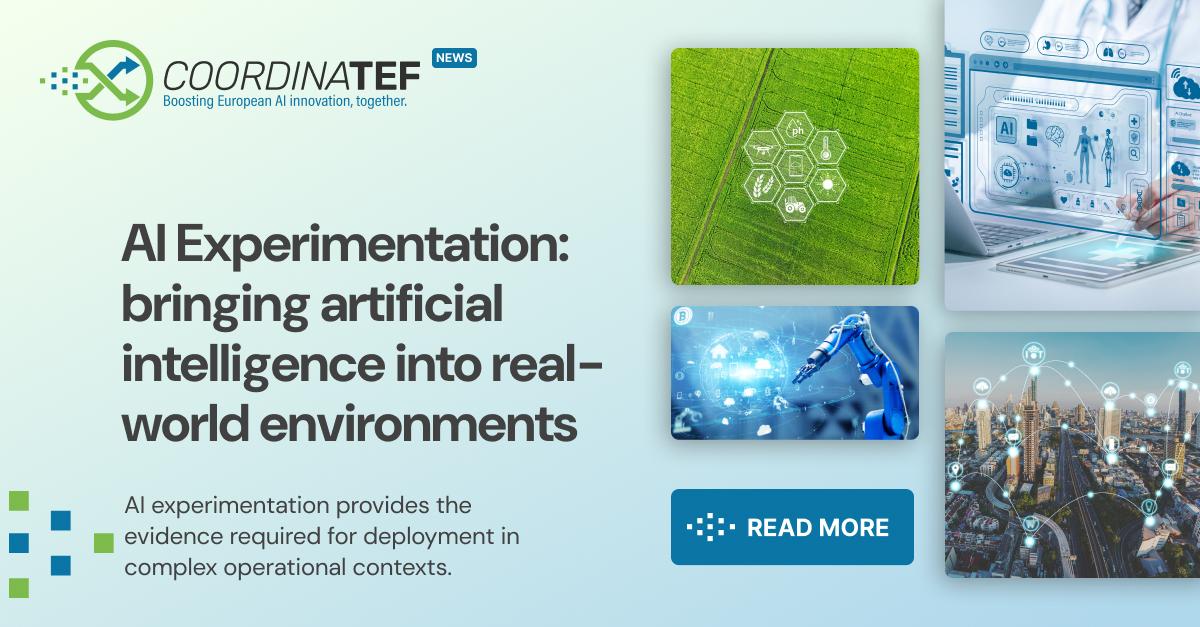
Artificial intelligence technologies are often developed and trained in controlled settings, where variables can be monitored and performance can be measured under predefined conditions. Yet the true value of an AI system only emerges when it is exposed to the complexity of real operational environments.
AI Experimentation provides the framework that allows this transition to take place. By enabling artificial intelligence solutions to be assessed, refined, and validated in realistic conditions, AI Experimentation helps bridge the gap between technological development and practical deployment.
As AI adoption expands across sectors, AI Experimentation is becoming an increasingly important step in ensuring that innovative technologies can operate effectively, safely, and efficiently beyond the laboratory.
Understanding AI Experimentation in practice
AI Experimentation refers to the activities through which artificial intelligence systems are evaluated in environments that reflect their intended use.
The purpose of AI Experimentation is not limited to measuring technical performance. It also involves observing how AI systems interact with users, infrastructures, processes, and external variables that may influence their behaviour once deployed.
Through AI Experimentation, organizations can gain valuable insights into how a solution performs under operational conditions, identify potential challenges, and collect evidence to support further development and adoption.
This process is particularly relevant for AI technologies, whose behaviour may depend on data quality, environmental conditions, human interaction, and other factors that are difficult to fully reproduce during development.
For this reason, AI Experimentation has become a key component of the artificial intelligence lifecycle, supporting the transition from innovation to real-world application.
Across Europe, Testing and Experimentation Facilities (TEFs) provide dedicated infrastructures where companies, researchers, and public organizations can conduct AI Experimentation activities in representative sector-specific environments.
AI Experimentation in the agrifood sector
Agricultural and food production environments are characterized by continuous variability. Weather conditions, biological processes, resource availability, and operational constraints can all influence the performance of AI-driven technologies.
Within agrifoodTEF, AI Experimentation supports the assessment of artificial intelligence solutions designed for agriculture and food systems.
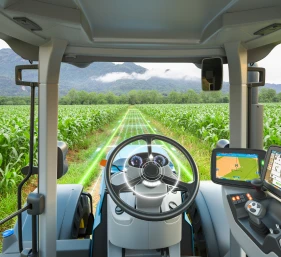
Experimentation activities may involve precision farming technologies, autonomous agricultural machinery, crop monitoring systems, resource optimization tools, and digital solutions for food production and supply chains.
By conducting AI Experimentation under realistic conditions, stakeholders can better understand how innovative technologies perform before their wider adoption.
AI Experimentation in smart cities and communities
Cities bring together interconnected infrastructures, public services, businesses, and citizens within highly dynamic environments.
This complexity makes AI Experimentation particularly important for technologies intended to support urban management and community services.
Through CitCom.ai, AI Experimentation can be carried out for solutions related to intelligent mobility, traffic optimization, energy management, environmental monitoring, digital public services, and urban resilience.
Real-world experimentation allows stakeholders to evaluate not only technical capabilities but also the interaction between AI systems and the broader urban ecosystem in which they operate.
AI Experimentation in healthcare
Healthcare environments require technologies that can demonstrate high levels of
reliability, safety, and effectiveness before they are integrated into clinical practice.
AI Experimentation plays a crucial role in generating evidence on the performance of artificial intelligence solutions intended for medical and healthcare applications.
Within TEF-Health, experimentation activities may involve clinical decision-support systems, medical imaging technologies, remote monitoring solutions, healthcare robotics, and predictive analytics tools.
AI Experimentation enables organizations to assess how these technologies function in realistic healthcare settings, supporting informed decisions regarding their future implementation.
AI Experimentation in manufacturing
Manufacturing industries are increasingly adopting artificial intelligence to enhance productivity, efficiency, automation, and operational flexibility.
Before these technologies can be integrated into production processes, however, their performance must be evaluated under conditions that reflect real industrial operations.
AI-MATTERS provides environments where AI Experimentation can be conducted for applications such as advanced robotics, predictive maintenance, quality control systems, process optimization tools, and human-machine collaboration technologies.
Through AI Experimentation, manufacturers can gain a deeper understanding of system performance and identify opportunities for improvement before large-scale deployment.
Experimentation as a driver of AI adoption in Europe
The growing adoption of artificial intelligence across strategic sectors is creating an increasing need for environments where innovation can be explored and validated under realistic conditions.
AI Experimentation responds to this need by providing structured pathways through which technologies can be assessed before they are introduced into operational settings.
In Europe, Testing and Experimentation Facilities contribute to this objective by offering sector-specific infrastructures that support innovation, collaboration, and technology uptake.
By connecting research activities, industrial development, and practical deployment, AI Experimentation helps create the conditions necessary for a more robust and trustworthy artificial intelligence ecosystem.
Why AI Experimentation matters
Moving an artificial intelligence solution from concept to practical use requires more than technical development alone. It requires evidence, observation, and a clear understanding of how the technology performs when exposed to real-world conditions.
AI Experimentation provides this opportunity. By enabling organizations to evaluate AI systems in representative environments, it supports better decision-making, reduces uncertainty, and facilitates the adoption of innovative technologies across multiple sectors.
Through the European network of Testing and Experimentation Facilities, AI Experimentation is helping transform artificial intelligence from a promising innovation into a practical tool capable of delivering value in real operational contexts.
To facilitate access to AI Experimentation services and support organizations interested in validating AI solutions, a dedicated CoordinaTEF helpdesk is available to provide information, guidance, and orientation across the European Testing and Experimentation Facilities ecosystem.