
Virtual services
Overview
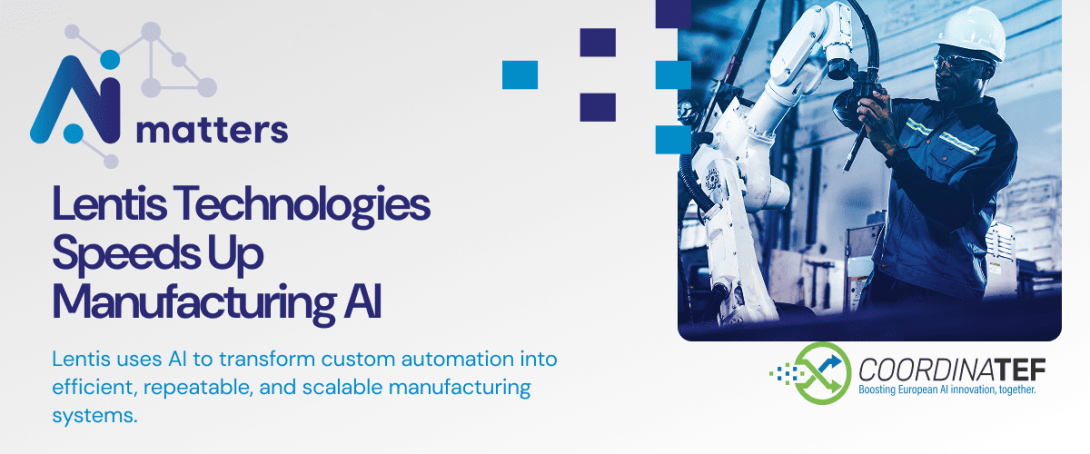
In serial manufacturing, delivering automation that is both fast to deploy and economically sustainable remains a key challenge. Lentis Technologies, an automation company and robot integrator, set out to respond to increasing customer demand for solutions that are not only efficient, but also flexible enough to be applied across different production processes.
Through its collaboration with AI-MATTERS, Lentis Technologies worked to move from highly customised projects towards more standardised, scalable approaches, leveraging AI to support this transition.
Impact
With the support of AI-MATTERS, Lentis Technologies achieved measurable progress:
- €30,000 in hard savings across implemented automation projects.
- Up to 6 months reduction in project execution time.
- Preparation of a concept solution for a fully autonomous Robotic AI Quality Inspector.
- Progress towards more standardised automation components in serial manufacturing contexts.
These outcomes demonstrate how targeted support and testing capabilities can help translate complex ideas into practical industrial solutions.
The Challenge
Lentis Technologies faced the challenge of developing an automation solution that could be deployed quickly, remain cost-effective, and scale across different manufacturing scenarios.
In an industry where solutions are typically highly customised, this required a shift towards more repeatable and configurable systems without compromising flexibility. At the same time, parts of the solution were technically complex and required extensive validation, creating the need for access to testing infrastructure and specialised expertise.
The Solution
Through AI-MATTERS, Lentis Technologies gained access to advanced testing facilities, technical guidance, and collaborative support activities. This enabled the development of a go-to-market version of an intuitive hardware configurator for machine vision projects.
In parallel, the company advanced the concept of a fully autonomous AI Robotic Quality Inspector, a system designed to operate across manufacturing environments, capture product images, learn quality characteristics, and perform automated quality control according to predefined standards.
This combination of infrastructure, expertise, and collaboration supported the validation of key components and helped prepare the solution for further industrial application.