Overview
Meldon is a family business that develops and manufactures plastic profiles for a wide range of applications. Its 95 employees run 27 extrusion lines around the clock in five shifts, and the company produces its own PVC compound and granulate as well as its own extrusion tooling. Automation is already part of the factory floor, with robots and camera systems on two production lines, but those cameras are about fifteen years old and due for renewal.
To work out what should replace them, Meldon took part in an AI-MATTERS experiment offered by Brainport Industries Coöperatie and carried out with Blue Engineering – AI-MATTERS’ Dutch hub formed by Brainport Industries, Eindhoven University of Technology and TNO. The aim was to find out which vision technology suits Meldon's processes and how its lines could be upgraded. As COO Stan Erens puts it, "If you want to remain relevant, you have to explore the possibilities."
Impact
The feasibility study showed that the line scan camera and Anomaly Detect together reliably separate damaged from undamaged material across different profile types. For Meldon, that is the basis for quality control during production rather than after it. "We now know which technology works for us and how we can improve our processes with vision and AI," says Erens.
The company now plans to collect and analyse quality data in a more targeted way, use that data to refine its process settings, assess whether the ageing camera systems on two lines can be replaced or upgraded, and introduce a new camera system for a further application. The findings have been presented to all of Meldon's engineers, who responded with enthusiasm. "Unknown makes unloved," Erens says. "Thanks to AI-MATTERS, our engineers now have a much better understanding of what AI and vision can do for us. That's exactly why we participated: to build knowledge and discover what's possible."
The Challenge
The experiment centred on an extrusion profile with strict requirements on visual appearance. Stains, scratches and scrapes regularly occur during production, and each one can mean a rejected product. These defects are usually spotted later in the process, because operators look after several lines at once and cannot watch the product continuously. With profiles between six and twelve metres long, tracing a defect back to the moment it occurred is difficult.
Meldon wanted to stop sorting good from bad at the end of the line. "We don't want to sort afterwards, but produce flawlessly right away," says Erens. "To achieve this, we need to make product quality measurable and recognise deviations during the process." Machine vision combined with AI offered a way to gather quality data in real time and adjust process settings accordingly.
The Solution
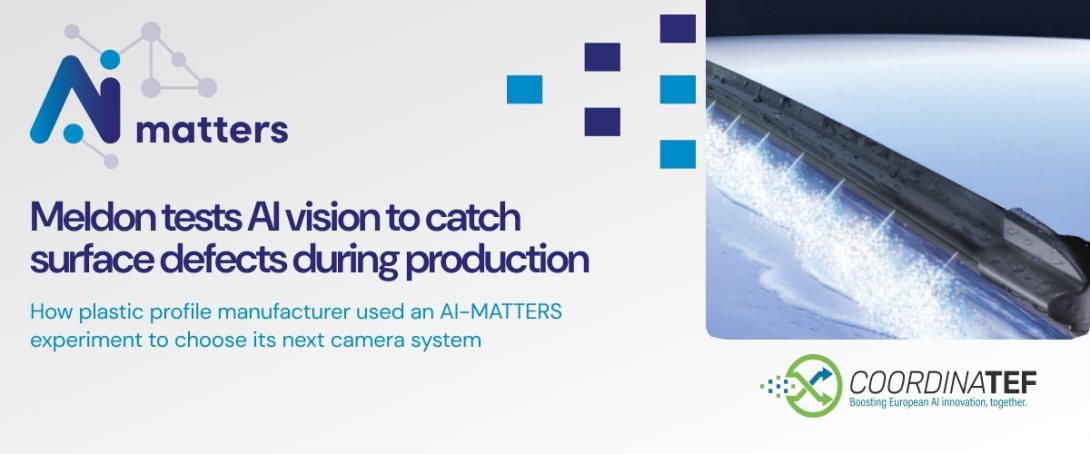
Blue Engineering tested several recording methods and AI techniques. A 2D line scan camera proved the best fit for a continuous process such as extrusion: it captures the profile line by line as it moves and needs little lighting, which keeps both the technical set-up and the cost manageable.
The images are analysed by Anomaly Detect, an algorithm trained only on pictures of good products. Anything that departs from that reference is flagged as an anomaly. This matters at Meldon because defects vary widely in shape, size and texture from one profile type to another, so listing every possible fault in advance would be impractical. "Many systems only recognise errors that you define in advance. That takes a lot of time," says Erens. "With Anomaly Detect, it works exactly the opposite way: you teach the model what is good, and it automatically recognises everything that does not belong." The system picked up subtle faults such as fine scratches, and engineers can raise or lower its sensitivity by adjusting a single threshold value.