

Physical services
Overview
Every hour, around 35,000 pastries move through Mette Munk’s production lines. Cinnamon rolls, pecan pastries, spandauers, and many other Danish specialties must all meet quality requirements before reaching customers worldwide. Yet, unlike standardized industrial products, pastries naturally vary in shape, filling, icing, and decoration.
For years, quality inspection relied heavily on human expertise. Operators visually assessed products at high speed, identifying defects and sorting items while maintaining a continuous production flow. As production volumes increased and product portfolios expanded, maintaining consistent quality through manual inspection alone became increasingly challenging.
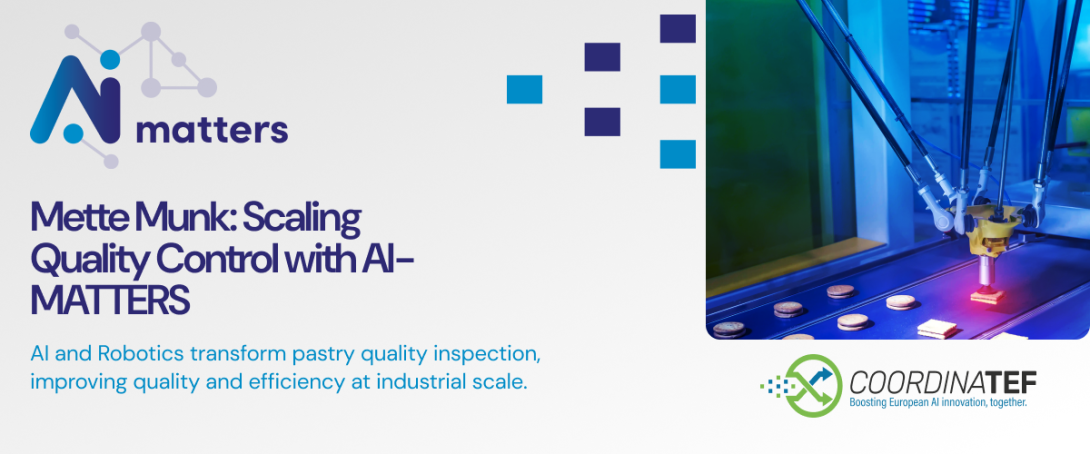
Through AI-MATTERS, Mette Munk partnered with Robot Nordic and the Danish Technological Institute (DTI) to develop an advanced solution combining artificial intelligence, machine vision, and robotics. The goal was to create a system capable of evaluating product quality in real time, handling significant product variation, and supporting high-volume operations without compromising flexibility.
The result is a fully automated quality control and sorting solution that enables robots to assess, sort, and handle pastries in a process that previously depended largely on human judgement. By combining AI-powered inspection with robotic automation, Mette Munk has taken an important step toward a more consistent and scalable production process.
Impact
The collaboration between Mette Munk, Robot Nordic, DTI, and AI-MATTERS led to the deployment of a large-scale automated system capable of managing quality inspection and product handling at industrial speed.
The solution includes:
- 16 robots operating across two production lines;
- Automated handling of up to 35,000 pastries per hour;
- AI-powered quality assessment trained on thousands of operator-labelled images;
- Real-time evaluation of approximately 24 pastries per scan;
- Inspection and decision-making completed in just half a second.
The system has given Mette Munk greater control over the flow from production to packaging while ensuring more consistent quality assessments across different product categories. At the same time, it has reduced the repetitive inspection and sorting tasks previously carried out manually, contributing to an improved working environment for employees.
As Jeppe Holm, Process Engineer at Mette Munk, noted, the company has achieved better control over production flow, more consistent quality, and a significant reduction in repetitive manual work through the implementation of the new solution.
The Challenge
Quality inspection in pastry production is particularly demanding because variation is not necessarily a defect.
Products may differ in appearance, filling distribution, icing patterns, or decoration while still meeting quality standards. Distinguishing acceptable variation from actual quality issues requires experience, product knowledge, and careful observation.
At Mette Munk, this challenge was amplified by scale. With tens of thousands of pastries moving through production lines every hour, operators were required to identify non-compliant products within a continuous and fast-moving process.
The company therefore needed a solution capable of recognising multiple pastry types, evaluating each according to its own quality criteria, and making reliable decisions despite significant variation between individual products. The challenge was not simply to automate a process, but to translate human quality assessment into a system capable of operating consistently at industrial scale.
The Solution
To address these challenges, Mette Munk worked with Robot Nordic and the Danish Technological Institute within the AI-MATTERS framework to develop and validate an integrated AI and robotics solution tailored to industrial pastry production.
The system combines robotic automation with multiple specialised AI models. One model identifies individual pastries, even when products are touching each other, while others perform product-specific quality assessments based on characteristics such as shape, filling, icing, and decoration.
Trained on thousands of operator-labelled images, the AI classifies products into three quality levels and supports automated handling decisions in real time. The vision system also analyses product and robot positions, identifies the optimal items to move, and communicates directly with the packaging line to adapt to different products and packing configurations.
The complete installation now enables 16 robots to coordinate sorting and packaging activities across two production lines, handling up to 35,000 pastries every hour.
By combining AI-powered vision with robotic automation, the project demonstrated how technologies traditionally associated with advanced manufacturing can successfully address complex quality control challenges in the food industry. Through AI-MATTERS, the solution was validated in a real production environment, creating a practical example of how artificial intelligence can support more efficient, consistent, and scalable food manufacturing processes.