

Physical services
Overview
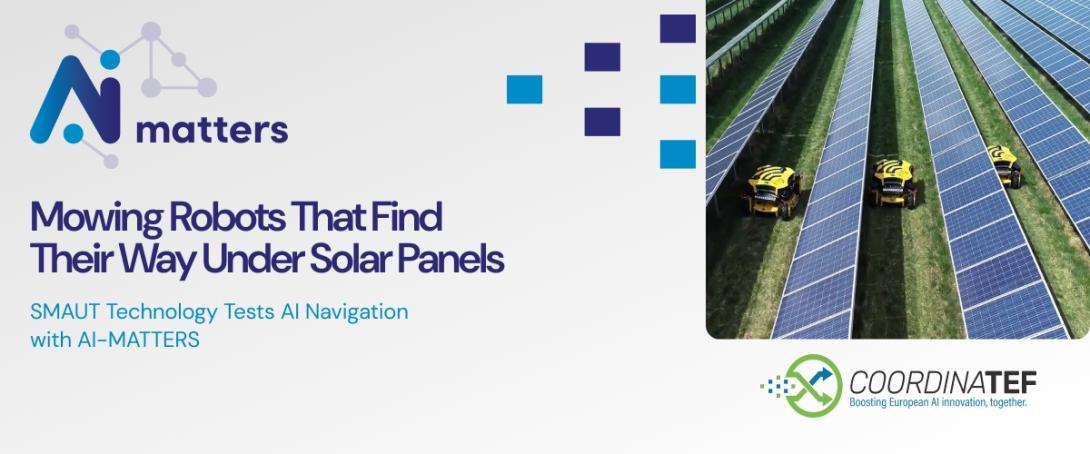
SMAUT Technology develops, builds and services fully autonomous industrial mowing robots for demanding sites such as solar parks, airports and large industrial estates. Its machines work without an operator on site, and, according to the company's CEO, Alan Ilczyszyn, they maintain more than 80,000 hectares every year, most of it in solar parks. Operators receive real-time feedback from the field through the company's software, which SMAUT regards as central to both safety and performance.
To make its robots more reliable in the conditions where mowing is hardest, SMAUT turned to AI-MATTERS. The work is carried out by the AI-MATTERS Czech Node through the Czech Institute of Informatics, Robotics and Cybernetics at the Czech Technical University in Prague (CIIRC CTU), using the equipment of its RICAIP Testbed Prague, a facility for testing and prototyping advanced industrial production technologies.
Impact
The collaboration is designed to deliver a prototype, or functional sample, ready for deployment and further testing. It brings together machine control and obstacle avoidance based on localisation and fused sensor data; the loading of a full site model with the machine's properties and configuration; a proof-of-concept integration of the new algorithms, generating fresh datasets from their use; and the final integration of these functions into the MySMAUT platform, followed by an evaluation of the system's resilience to cyberattacks and an audit using the Splunk operational-security platform.
For SMAUT, the most valuable result is a mower that adapts rather than simply follows a pre-set path.
"Our mowers don't just follow paths — they learn, adapt, and optimise their behaviour in real time," says Alan Ilczyszyn. "All of this gives us the confidence to offer our customers even more reliable, secure, and autonomous solutions — ready for the real world."
The partnership has also reached audiences well beyond the lab. SMAUT took part in the "United by Innovation" joint exhibition at the International Engineering Fair in Brno (MSV Brno 2025), where RICAIP Testbed Prague acted as technology lead within the Digital Factory 2.0 programme coordinated by the National Centre for Industry 4.0. The story has since been presented at the third xTEF event in Milan, which brought together the four sectorial AI TEFs and CoordinaTEF, and at the AI Festival for Everyone, hosted by the Czech Ministry of Industry and Trade in Prague.
The Challenge
A mowing robot in a solar park faces problems that a road vehicle rarely meets. Beneath rows of photovoltaic panels, satellite positioning signals are weak or blocked altogether, so the machine must know where it is without relying on GNSS. Tall grass can hide obstacles and confuse sensors, while temporary objects, people or other vehicles may appear without warning. Each new site also has to be mapped before the robot can start work, and the maps must be updated whenever the machine meets something unexpected. Because the fleet is connected and managed remotely, the whole system must also be protected against cyberattacks.
SMAUT needed expert support across three areas: sensor systems for localisation and obstacle detection, the automation of mapping and commissioning, and the AI algorithms running inside its SMAUT Autonomous control system and its MySMAUT operational platform.
The Solution
Through AI-MATTERS, SMAUT gained access to the RICAIP Testbed Prague facilities, together with prototyping, testing and algorithm development by the CIIRC CTU team. The partners have trained AI models for obstacle recognition, localisation and mapping, and implemented machine control based on fused data from LiDAR, cameras, radar and ultrasonic sensors. The work also covers data recording, map generation and route optimisation, and the integration of the new algorithms into the SMAUT Autonomous system and the MySMAUT platform, with their resilience to cyberattacks tested along the way.
Testing in a controlled but realistic setting shortens the path to the field. As Pavel Burget, Director of RICAIP Testbed Prague at CIIRC CTU, puts it:
"New AI algorithms are tested in the near-real environment of RICAIP Testbed Prague thanks to the equipment we have already had. Therefore, the transition to the final machine is more straightforward and the evaluation in the real environment is faster."
For Ondřej Beránek, Head of the Czech Node office at CIIRC CTU, the collaboration shows what the TEF model offers smaller firms:
"TEF helps small and medium companies to test, verify and deploy new advanced technologies across Europe and also across the client's technology and value chain."