
Physical services
Overview
KERANOVA is a French medical technology company developing FemtoMatrix®, a robotic platform for ophthalmic surgery. The system brings together a femtosecond laser, OCT-based imaging (optical coherence tomography, which produces detailed cross-sectional images of the eye) and a robotic arm to assist surgeons with key steps of cataract surgery. These include the anterior capsulotomy, the circular opening made in the lens capsule, and lens fragmentation through the company’s PhotoEmulsification® technology. The aim is a cataract procedure that is more precise, more reproducible and less dependent on the individual operator.
Before a device of this kind can reach patients, its manufacturer has to show that the people who will use it can do so safely. To build that evidence, KERANOVA worked with Hospices Civils de Lyon (HCL) through its innovation and testing facility Station H, a service provider within TEF-Health, the European Testing and Experimentation Facility for AI and robotics in healthcare.
Impact
The evaluation gave KERANOVA independent, user-based and fully documented evidence to support its usability engineering process and the validation of FemtoMatrix®. Because the study was run by a hospital-based facility, with practising surgeons in a realistic operating environment and under a recognised international standard, the findings carry weight both in regulatory documentation and in conversations with future clinical users. For a small medtech company, access to this kind of infrastructure and expertise through TEF-Health removes the need to build a simulated surgical environment and an evaluation team from scratch, allowing it to focus its resources on the technology itself.
The Challenge
Usability engineering for medical devices follows a structured process, set out in the international standard IEC 62366-1, which runs alongside the manufacturer’s risk management. Early, formative studies help developers identify where users might go wrong and refine the design accordingly. The final summative evaluation has a different purpose: rather than uncovering new use-related risks, it must demonstrate that those already identified have been adequately controlled and that the device can be used safely by its intended users. This matters under the EU Medical Device Regulation, which requires manufacturers to reduce as far as possible the risks arising from use error.
For KERANOVA, this meant finding a partner able to recruit ophthalmic surgeons representative of the system’s future users, recreate a realistic surgical environment, and run the evaluation strictly according to a predefined test protocol while taking account of the device’s existing risk analysis. Conducting such a study credibly also calls for independence from the development team.
The Solution
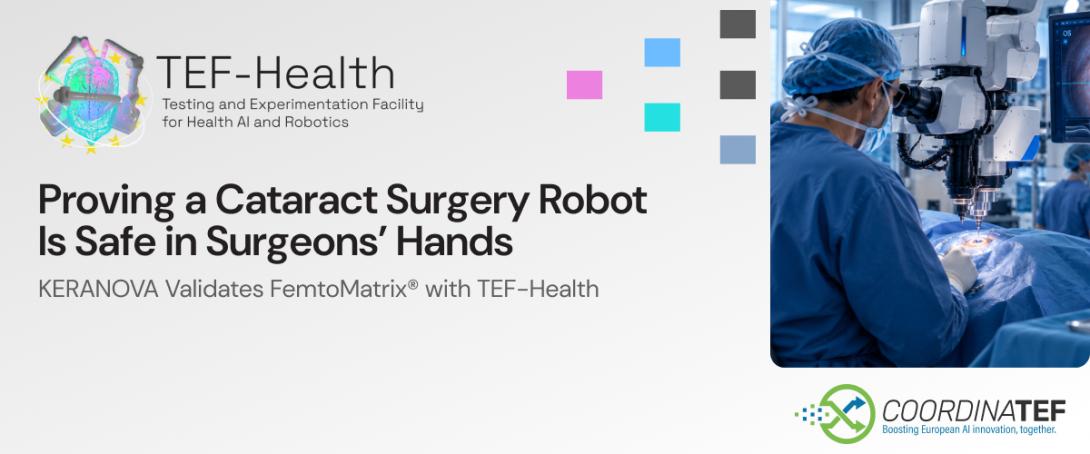
Station H began by recruiting ophthalmic surgeons matching the profile of FemtoMatrix®’s intended users. The test sessions then took place in a simulated operating room at Station H, where each surgeon carried out the predefined tasks and interacted with the robotic system in conditions representative of real clinical use.
Throughout the sessions, the Station H team systematically collected and analysed observations in line with IEC 62366-1, classifying use-related events such as use errors and close calls. Every session was video-recorded, giving a complete and reviewable record of how surgeons handled the system. Station H then produced a test report documenting and classifying all observations and assessing the results against the acceptance criteria defined in advance.
Explore the services offered by TEF-Health, and get in touch with the team through the CoordinaTEF Helpdesk.