

Physical services
Overview
Food factories face a persistent challenge: many critical inspection zones are too hazardous, confined, or structurally awkward for human workers to access safely. Inspecting pipes, overhead production areas, and confined spaces for contamination, corrosion, or wear is non-negotiable, yet conventional technology seldom fits the bill. Drones lack manoeuvrability, large robotic arms cannot navigate tight spaces, humans risk injury.
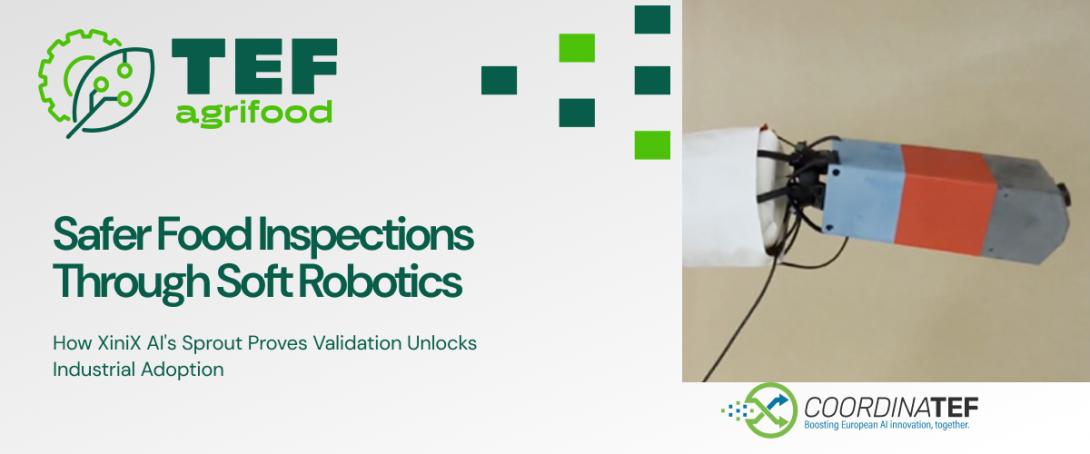
XiniX AI ApS, a Copenhagen-based robotics company, developed Sprout a soft, flexible robot that can squeeze into confined spaces, navigate pipes, and detect hazards using integrated sensors. The technology is sophisticated to address the commercial challenge that is clear. Before food facilities will install an unfamiliar robot in production environments, they need proof that it works reliably under realistic conditions. That proof came through validation work undertaken in partnership with agrifoodTEF's Danish Node, managed by the Danish Technological Institute (DTI).
Over several months, XiniX AI subjected Sprout to rigorous testing in controlled laboratory settings designed to replicate genuine food production scenarios. Mechanical refinements emerged from this process – a new retraction system, enhanced sensor integration – strengthening the robot's capability. With documented evidence of performance, Sprout is now positioned for live factory deployment.
Impact
Sprout is now substantially closer to operational deployment. The combination of structured laboratory validation and documented performance evidence provides industrial food facilities with objective grounds for adoption. Rather than asking facilities to trust an unproven technology, XiniX AI can now present credible performance data compiled by a neutral testing partner. This evidence-based approach materially accelerates commercial adoption and reduces hesitation among cautious industrial buyers.
For XiniX AI, the commercial dividend is tangible. Facilities no longer require extensive pilot periods to evaluate Sprout, the testing has already been completed by recognised experts. The documentation provides both reassurance and compliance grounds – facilities can justify the adoption decision to safety and quality teams based on third-party validation. This substantially shortens sales cycles and lowers customer acquisition cost.
For the food production sector itself, the benefit is equally clear. Facilities gain access to a proven technology that addresses a persistent operational challenge – safe, reliable inspection of hazardous or inaccessible spaces. As Sprout moves into live deployment, food companies will be able to reduce manual inspection workload, improve safety, and enhance contamination detection, all whilst building a track record of success that encourages peer adoption.
Beyond individual commercial gains, Sprout's pathway through structured validation demonstrates a broader principle: rigorous testing is not a barrier to deployment – it is an accelerant. By grounding new technology in objective evidence rather than conjecture, companies reduce adoption friction and build customer confidence. For the agri-food sector's broader robotics adoption agenda, this approach offers a replicable model: innovators who invest in third-party validation, rather than rushing to market on hype, ultimately reach customers faster and more securely.
The Challenge
Food production demands uncompromising hygiene and safety standards. Inspectors must verify that pipes, confined production spaces, and overhead areas are free of contamination, rust, or structural defects, yet accessing many of these zones poses real risk. Manual inspection by humans is slow, hazardous, and incomplete. Existing robotic solutions, including aerial drones, typically lack the physical flexibility or sensor sophistication required to operate effectively in tight, complex environments.
For XiniX AI, the commercial pathway was clear but risky. Selling Sprout to cautious industrial buyers required more than technical specification sheets. Food production facilities – where regulatory compliance and contamination control are paramount – were unlikely to adopt an untested technology without objective evidence of reliability in realistic scenarios. The company recognised that structured, third-party validation would substantially reduce adoption barriers and unlock market opportunity.
The Solution
DTI's testing programme provided a comprehensive validation pathway, structured around four complementary activities. The first phase involved simulated environment testing: Sprout was deployed in dedicated laboratory settings that reproduced the physical and operational demands of genuine food factory scenarios – navigating pipe networks, detecting accumulated debris or corrosion, manoeuvring through confined spaces that mirror real production layouts. These were not abstract tests but purpose-built replications of conditions Sprout would face in deployment.
Second, XiniX AI and DTI collaboratively validated Sprout's inspection protocols against established food factory safety standards. The testing examined whether the robot's sensor systems reliably detected hazards like dirt, rust, and potential contamination vectors, according to the rigorous standards that food facilities apply. This validation ensured that sensor data would be trustworthy and actionable for industrial customers.
Third, all findings were rigorously documented. DTI compiled detailed performance records, sensor readings, mechanical behaviour, and failure modes – creating an evidence base that regulators, partners, and prospective customers could scrutinise. This documentation transforms Sprout from a promising prototype into a validated system with an auditable track record.
Fourth, laboratory feedback directly informed mechanical improvements. The retraction system was redesigned to enhance reliability in confined spaces. Sensor integration was upgraded to improve detection accuracy and data transmission. These refinements emerged from real testing experience rather than theoretical speculation, making them directly responsive to deployment demands.
Parallel to validation work, XiniX AI engaged with potential industrial partners to prepare for the transition from testing to live factory trials. The next phase will integrate advanced navigation technologies – LiDAR and SLAM (Simultaneous Localisation and Mapping) – and test Sprout in operational food production environments. This staged approach, moving from controlled testing to supervised real-world deployment, substantially reduces commercial and technical risk.
If your food production facility faces inspection challenges in confined or hazardous zones, or if you are an innovator developing robotics or AI solutions for food production and need structured testing and validation, agrifoodTEF can help. Discover what testing and validation services are available, or reach out directly to the agrifoodTEF helpdesk to discuss your innovation challenge or operational needs.