
Physical services
Overview
Operating in highly specialized sectors such as marine, automotive, and defence, TRYGONS has progressively consolidated its role as a manufacturer of high-performance composite components for mass-production environments. Within this context, characterized by increasing demands in terms of precision, efficiency, and process reliability, the integration of artificial intelligence technologies emerged as a concrete operational necessity.
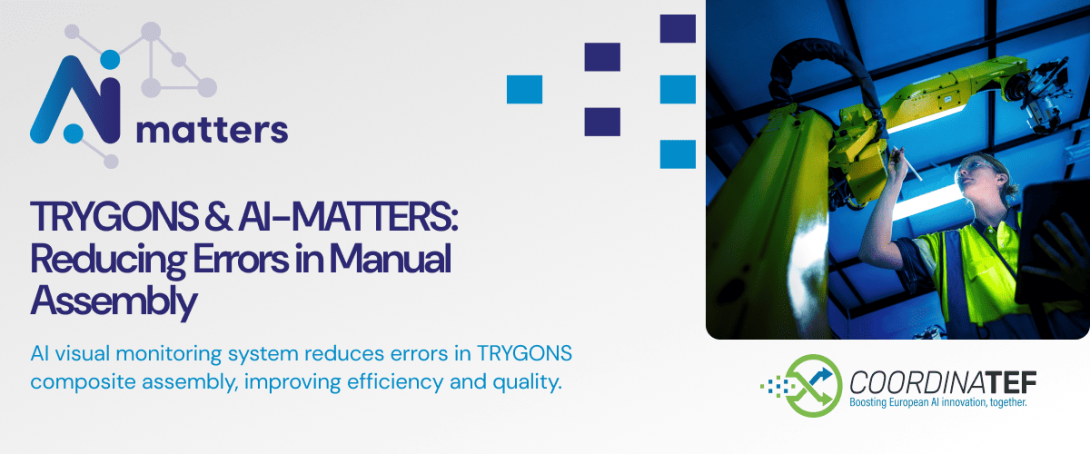
Through the framework provided by AI-MATTERS, TRYGONS developed and validated an AI-based visual monitoring system aimed at supporting manual sandwich structure assembly, one of the most delicate and error-sensitive phases of the composite manufacturing process. The initiative sought to address recurrent issues linked to mismatching and misalignments during manual operations, phenomena capable of compromising product integrity, generating material waste, and requiring costly rework interventions.
By combining AI-driven visual assistance with real-time operator support, the project enabled TRYGONS to explore a more adaptive and data-informed production approach, while simultaneously testing the practical integration of advanced AI solutions into existing industrial workflows under realistic operating conditions.
Impact
The collaboration between TRYGONS and AI-MATTERS produced tangible operational results, demonstrating how AI technologies can contribute concretely to improving efficiency, quality assurance, and process reliability within advanced manufacturing environments.
More specifically, the implementation of the visual monitoring systems led to:
- A 20-25% reduction in production time during the sandwich assembly stage, achieved through the minimization of operator delays and faster decision-making processes;
- Around 10% reduction in rework activities, thanks to improved placement accuracy and earlier detection of assembly inconsistencies;
- A 5-10% decrease in material waste, resulting from the prevention of mismatches and the reduction of scrapped components.
Beyond the quantitative dimension, the project also generated important qualitative improvements on the shop floor. Through continuous visual feedback and real-time verification of assembly actions, operators experienced a reduction in mental workload and operational uncertainty, particularly in relation to high-precision manual tasks where errors may entail significant economic and production consequences.
As noted by Evagoras Zervas, European Project Coordinator and Mechanical Engineer at TRYGONS, the experience contributed to repositioning AI “not just as a future concept, but as a practical tool to improve everyday operations.”
In this sense, the initiative highlighted not only the technological viability of AI-assisted manufacturing processes, but also their capacity to foster greater confidence, consistency, and engagement among operators within complex industrial settings.
The Challenge
Within composite manufacturing, manual sandwich assembly represents a particularly sensitive phase of production, requiring high levels of precision, consistency, and operator attention. Even limited alignment inaccuracies may compromise structural integrity, increase material consumption, and necessitate expensive corrective interventions downstream.
TRYGONS therefore faced a dual challenge. On the one hand, the company sought to improve the reliability and repeatability of manual assembly operations in a mass-production environment increasingly oriented toward efficiency and quality optimization. On the other hand, it needed access to specialized AI expertise and testing infrastructures capable of supporting experimentation under realistic industrial conditions without disrupting ongoing production activities.
More broadly, the challenge was not confined to the mere adoption of a technological tool. Rather, it concerned the possibility of validating AI-driven solutions in a structured, low-risk, and operationally compatible framework, capable of bridging advanced technological development with the concrete constraints of industrial manufacturing.
The Solution
Through AI-MATTERS, TRYGONS gained access to a structured ecosystem of technical expertise, validation facilities, and methodological support necessary to design, test, and evaluate an AI-powered visual monitoring solution tailored to manual sandwich assembly operations.
The project combined AI-based visual inspection mechanisms with real-time operator assistance functionalities, allowing the system to support workers during one of the most error-prone stages of the production cycle. Importantly, all development and testing activities were conducted under realistic operational conditions while remaining fully non-disruptive to existing manufacturing workflows.
The close collaboration established with AI-MATTERS experts enabled TRYGONS to refine the solution progressively, ensuring both technological robustness and compatibility with production requirements. In doing so, the company was able to strengthen its broader strategic confidence in the adoption of AI technologies across additional stages of the production line.
Looking ahead, TRYGONS intends to further expand the integration of AI-driven tools within its manufacturing processes, with particular attention to real-time decision support, quality control enhancement, and increased process adaptability in increasingly complex industrial environments.