
Physical services
Overview
Restoring autonomy in everyday life is one of the most meaningful goals of assistive robotics. Turning that ambition into a clinically validated solution, however, requires robust evidence and a clear regulatory pathway.
Within the TEF-Health ecosystem, the collaboration between Politecnico di Milano (PoliMi) and AllyArm Srl demonstrates how targeted clinical evaluation can support the development of innovative rehabilitation technologies.
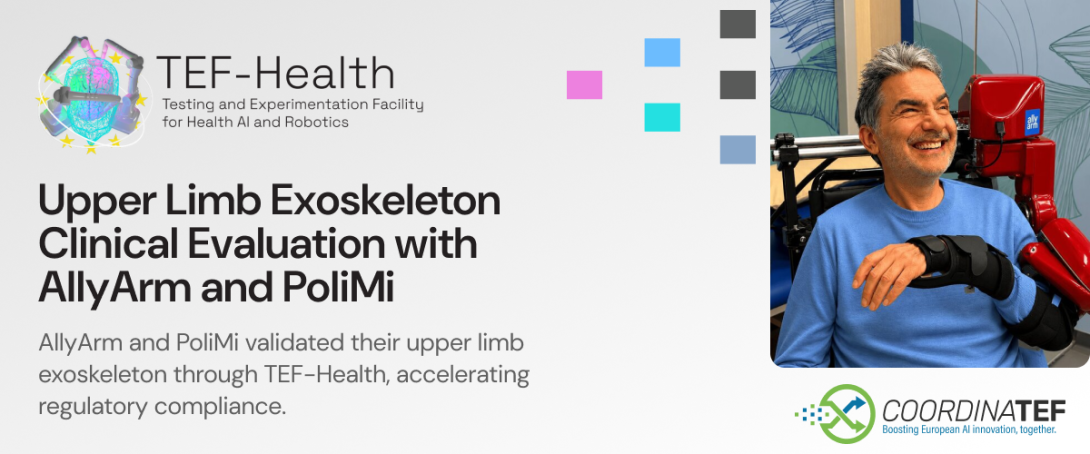
AllyArm, an Italian startup specializing in assistive robotics, developed ALLY-06, an upper limb exoskeleton designed to help people with severe neuromotor impairments perform everyday activities more independently. Mounted directly on a wheelchair and operated through multiple control interfaces, including joystick, app-based interaction, and voice commands, the system adapts to users’ individual abilities and needs.
To strengthen its validation pathway and support regulatory compliance, AllyArm engaged with TEF-Health to assess the clinical equivalence of ALLY-06 with the previously validated BRIDGE exoskeleton. Through expert support and dedicated evaluation activities, the project generated the evidence needed to bring the technology closer to market adoption.
Impact
The project marked an important step forward in the validation and regulatory journey of ALLY-06.
By demonstrating clinical equivalence with the BRIDGE exoskeleton, AllyArm was able to leverage existing clinical evidence and accelerate compliance with MDR 2017/745 requirements. The assessment confirmed comparable technical, kinematic, and clinical characteristics between the two systems, strengthening the credibility of the new device.
The impact extended across multiple dimensions:
• Demonstration of clinical equivalence through structured evaluation,
• Leveraging existing clinical evidence to support regulatory compliance,
• Acceleration of the validation pathway under MDR 2017/745,
• Increased confidence among stakeholders and future adopters,
• Faster progression toward real-world deployment.
The device was ultimately certified as a Class I medical device, marking an important milestone in its path to supporting greater independence for people with severe neuromotor impairments.
The Challenge
For emerging assistive technologies, generating sufficient clinical evidence can be both resource-intensive and time-consuming.
AllyArm needed to demonstrate the clinical effectiveness of ALLY-06 while meeting the requirements of MDR 2017/745. Rather than duplicating extensive clinical investigations, the company sought to establish clinical equivalence with the BRIDGE exoskeleton, a system already supported by clinical studies and scientific publications.
Achieving this objective required a rigorous assessment of the two devices’ technical, kinematic, and clinical characteristics, ensuring that existing evidence could be reliably transferred within the regulatory framework.
The Solution
To address these validation needs, Politecnico di Milano provided support through TEF-Health's clinical evaluation services.
The collaboration included:
• Technical and kinematic comparison of the two exoskeletons,
• Assessment of clinical characteristics and intended use,
• Clinical evaluation aligned with MDR requirements,
• Expert support throughout the validation process.
The assessment confirmed the comparability of the two systems, enabling AllyArm to build upon existing clinical evidence while reducing time and complexity in the validation pathway.
This collaboration highlights how TEF-Health helps healthcare innovators accelerate the journey from technological development to validated deployment. By combining advanced robotics with evidence-based evaluation, AllyArm moved one step closer to making independent daily living more accessible for people with severe neuromotor impairments.